
I have always loved history but now I am REALLY loving Art History! I learned tons of amazing things while I took this class but the feminism and female representation through the expressionism movement as well as others has been extremely fascinating.
One of my lessons was to create a very small art gallery of specific works of art on Google Arts & Culture. I want to post some of the work i’ve done for classes almost to keep for myself but also to share. Hope you enjoy browsing some of the favorites I chose from the Expressionism movement!
Link to Gallery —> https://artsandculture.google.com/favorite/group/6QLyPCqQSfA3IA
I also needed to do some light research on a politically driven piece of artwork. The work of art I chose is The Dinner Party by Judy Chicago in 1974-1979. Judy Chicago was a feminist artist who created a collaborative art environment made up of 21 women known as Womanhouse. Womanhouse led to The Dinner Party which is a mixed-media installation that depicts a triangle composed of white tiles. The dimensions are 48′ × 42′ × 3′ (14.6 × 12.8 × 1 m). On top, is a triangular table with painted porcelain, plates, and needlework. The Dinner Party took five years of collaboration with hundreds of women and men of all talents. Judy Chicago wanted to celebrate women and empower them through this work of art. She wanted to change the social customs that were placed on women and shed light on the oppression they faced.
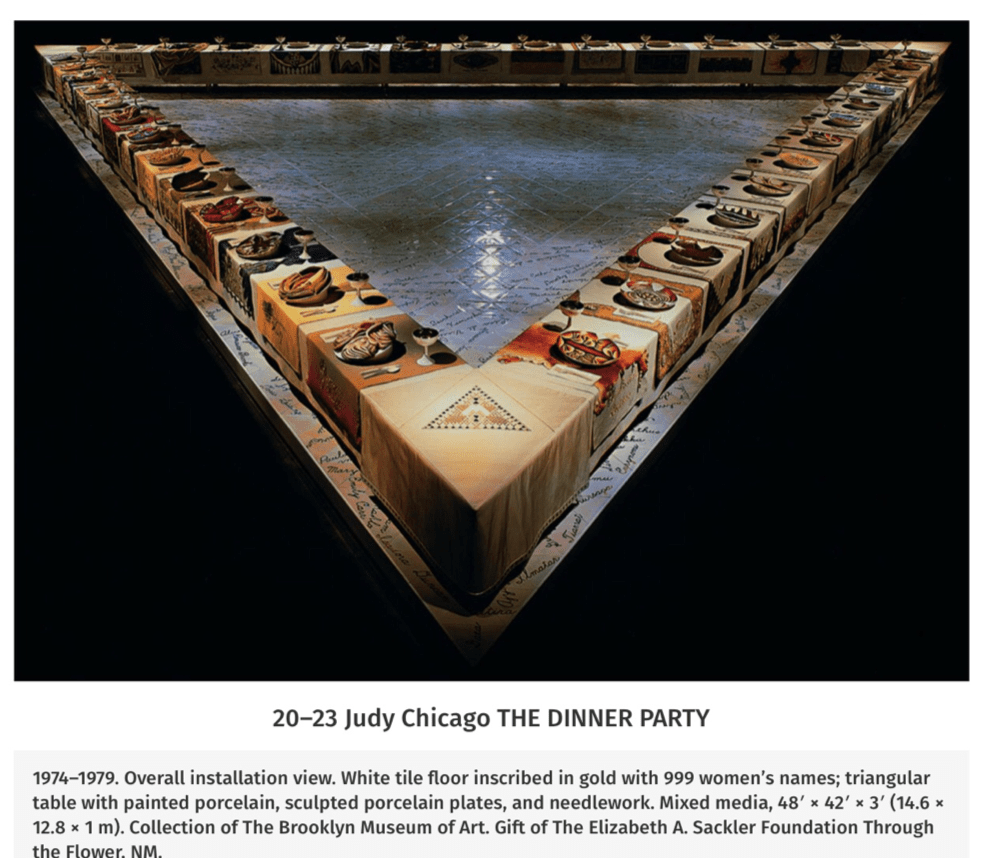
There are many visual imageries and clues in the artwork that convey the message of feminism. There are 2,300 white tiles that compose the base of the installation. The tiles are inscribed with 999 names of notable women. The triangular table is 48 feet long on each side. There are 39 place settings on the table representing famous women such as Georgia O’Keeffe. Judy Chicago emphasized needlework and china painting to honor craft media which was practiced traditionally by women. The china amongst the table featured abstract designs that resembled female genitalia to convey the message that this was the only thing that unified all of these beings and also what kept them oppressed. Chicago identified the equilateral triangle as the earliest symbol of the feminine.
In today’s society, images are everywhere. They serve many purposes in our life considering we have become heavily reliant on technology. We use images for many reasons: to advertise, inform and express ourselves. However, we also use images to learn. The Dual-coding theory was created by Allan Paivio who believes that images aid in learning.
References
Chicago, Judy (1974-1979). The Dinner Party [mixed-media installation]. Retrieved from https://bookshelf.vitalsource.com/#/books/9781269534314/epubcfi/6/60[idloc_029.xhtml-itemref]!/4[eid18667]/42[eid19168]/14[eid19195]/2[eid19200]@0:0
Clark, J. M., & Paivio, A. (1991). Dual coding theory and education. Educational Psychology Review, 3, 149-210.
 Annette's Adventures